
WCBR LN
WisdomTree Cybersecurity UCITS ETF - USD Acc

Published 10 April 2025

Associate Director, Quantitative Research
The cybersecurity space continues to make headlines amidst rising geopolitical tensions and the ever-evolving threat landscape that has recently been boosted by the proliferation of generative artificial intelligence (AI). Ongoing digitalisation and the global urge to safeguard digital assets, infrastructure, and data, creates a virtuous cycle for cybersecurity to sustain continuous growth in the years to come. Yet, the macroeconomic backdrop and shifting corporate priorities and spending complicate short-term growth paths for cybersecurity companies. The most recent earnings season provided valuable insights into how cybersecurity companies aim to navigate these challenges while positioning themselves for years of future growth. Several trends, underscored in the earnings cycle, should be on cybersecurity investors’ radars:
1. Growth vs profitability
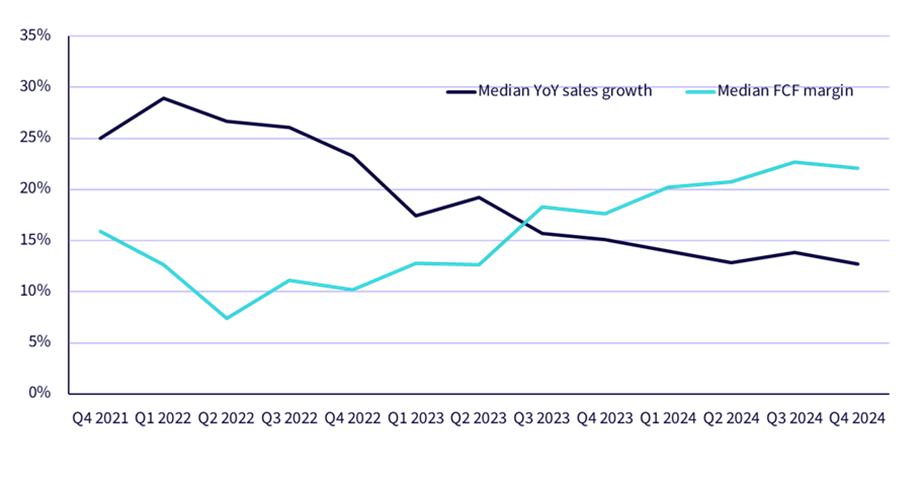
With investor preferences pulling away from growth following the start of the global value rotation, a notable shift toward profitability has taken hold in the past two years, as software and cybersecurity vendors focused on delivering margin expansion and positive free cash flow. However, to realise higher long-term growth, it is essential for cybersecurity companies to start investing more into new opportunities and growth. The latest earnings reports do show a growing focus on leveraging AI in cybersecurity offerings, platformisation opportunities, as well as stronger demand expected on the back of AI-associated risks. With new growth opportunities created by AI, geopolitical risks, and ongoing digitalisation trends, a pivot towards improving growth might happen when macroeconomic conditions start improving, together with investor sentiment and appetite shifting toward growth opportunities rather than profitability.
2. More cautious forward guidance
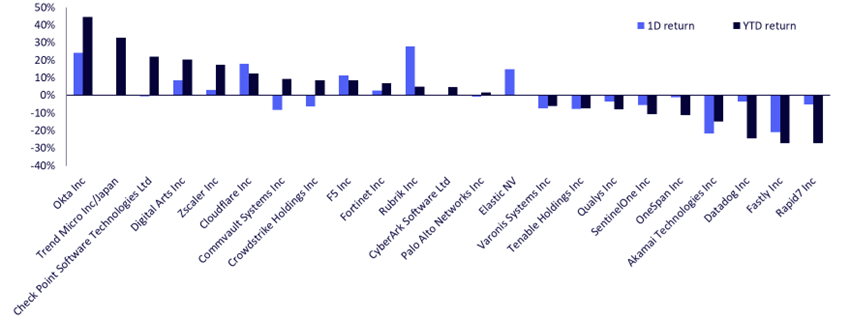
In light of interest rate uncertainties and possible tariffs, some cybersecurity providers have guided investors more conservatively in terms of revenues in the fiscal period and year. Following the global value rotation, investors have been focusing much more on the expected growth rather than past fiscal period beats. The current season was no exception as the current macroeconomic backdrop made investors even more sensitive to company outlooks below analyst estimates. The bottom 5 companies by year-to-date returns have all issued lower than expected forward guidance, although some of them, for example, Datadog and SentinelOne, delivered confident beats, some of the strongest YoY growth rates (above 25%) and are well positioned to capture the growth offered by AI opportunities.
3. Leveraging AI for productivity and improved solutions
AI has become a cornerstone of product differentiation for software companies. With the rising speed and sophistication of attacks and shortage of cybersecurity talent, importance of AI developments for cybersecurity is undeniable. Companies are prioritising their AI investments to drive their own efficiency and productivity gains, as well as to increase the attractiveness of their offerings for clients. For example, Palo Alto saw an uptick in customers opting for its AI-enabled services and features, and, notably, was able to increase prices for offerings with AI add-ons. Even though some cybersecurity companies have been already leveraging AI in threat intelligence and detection, automation of incident response and data analytics, one additional avenue that companies have started tapping into is secure use of generative AI apps and prevention of data leakage into large language models (LLMs).
4. Shift to platform approaches
Providing a comprehensive security suite is becoming the key strategy for cybersecurity companies to win new customers, drive higher retention rates and, ultimately, drive revenue growth. As organisations grapple with an increasingly complex and interconnected threat landscape, sticking to single vendors allows customers to address a range of security needs, while minimising integration challenges and streamlining operations. Consolidation of solutions in one platform not only improves visibility and operational efficiency but also delivers significant cost savings by reducing the need for multiple vendor contracts. Cybersecurity platforms also integrate AI capabilities offering customers to do more with fewer resources. Palo Alto, Zscaler, CrowdStrike, Cloudflare, Trend Micro, Rubrik, SentinelOne, and Fortinet are some examples of companies that actively discussed their platforms in the latest earnings calls.
5. Partner ecosystems and future growth
Partnerships with major cloud providers, resellers, and managed service providers have emerged as powerful avenues for expanding market reach. These alliances can accelerate product adoption and provide additional sales resources without heavy internal cost, which helps companies improve their operational efficiency and expand margins. CrowdStrike, for instance, reported that partners contributed 60% of its new business, citing AWS Marketplace as a prominent channel. CrowdStrike was the first cybersecurity independent software vendor (ISV) to cross $1 billion in deal value on AWS Marketplace in a single calendar year. In turn, Okta highlighted the role of its partner ecosystem in landing larger, multi-module deals, as the company broadened its identity management solutions. Supporting this statement is the title “Partner of the Year” awarded to Okta by AWS Marketplace.
Conclusion
As cybersecurity companies chart their course through a complex macroeconomic and technological landscape, the long-term winners will be defined not just by their ability to innovate, but by how well they align growth strategies with evolving customer needs, partner ecosystems, and AI-driven efficiencies. The convergence of AI, platformisation, and strategic alliances is setting the stage for a transformative era in cybersecurity, one that investors shouldn’t ignore when building their thematic and tech allocations.
WisdomTree Cybersecurity UCITS ETF - USD Acc

Associate Director, Quantitative Research
Elvira has been a member of the WisdomTree Research team since September 2018. With over nine years of experience in the ETF and asset management industry and an academic background in quantitative finance, Elvira combines technical expertise with thematic strategy insights to contribute to thought leadership research and the development of new innovative strategies at WisdomTree. As a lead specialist in thematic strategies, she supports the periodic review and rebalancing of thematic portfolios, delivers quantitative insights, bespoke analysis for clients, strategic thought pieces as well as commentary on market trends and thematic strategies. She also develops comprehensive product collateral designed to support client needs.

