

Exploring the risks and opportunities of staking Crypto ETPs
Published 28 March 2024

Contributor
Key Takeaways
- Staking in crypto ETPs is an opportunity to earn additional yield but comes at the cost of additional risks.
- The staking process is relatively complex and many parameters eventually affect what investors and the issuer get from it.
- WisdomTree provides a risk managed and transparent approach to staking.
- Related Products WisdomTree Physical Ethereum, WisdomTree Physical Solana Find out more
In the rapidly evolving landscape of cryptocurrencies and blockchain technology, one concept gaining increasing attention is staking in exchange-traded products (ETPs). Staking offers participants the opportunity to earn a yield on their investment in cryptocurrency by actively engaging with different blockchains. This could be a game changer, making crypto investments even more attractive to institutional investors. However, navigating the complexities of staking within an ETP requires a nuanced understanding of its mechanisms to ensure both participation and liquidity.
Risks and benefits for ETP investors
Staking provides a means for users to earn passive income by simply holding and staking their cryptocurrency holdings. Participants are rewarded with additional coins for their contribution to the network's security and consensus mechanism. Hence, investors in an ETP involved in staking should get a better performance over time compared to a product tracking the same underlying asset without staking.
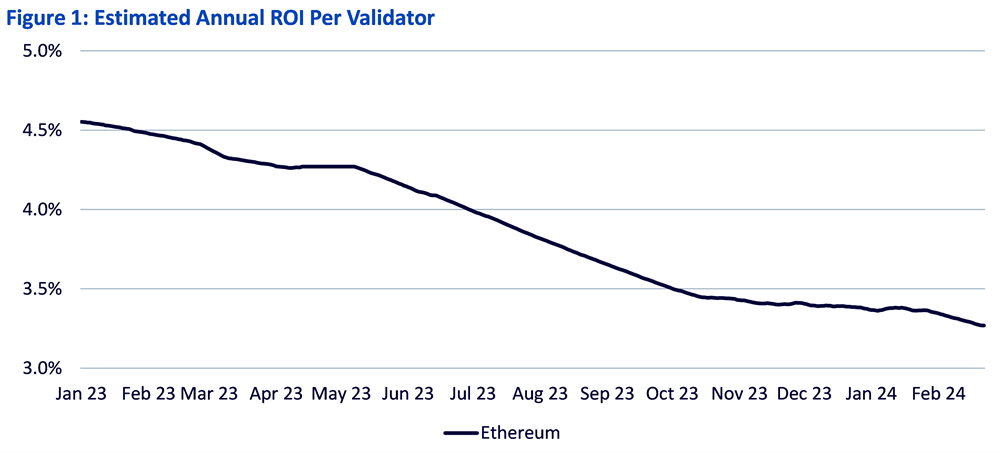
Source: WisdomTree, Glassnode. Historical performance is not an indication of future performance and any investments may go down in value.
However, there’s no such thing as a free lunch, and physical crypto ETPs that engage in staking face additional risks:
- Liquidity risk: Staked assets typically have to go through a lock-up period during which validators can’t withdraw their staked coins from the network. ETPs need to be structured in a way that still allows investors to redeem at all times from the fund. Furthermore, the lock-up period may vary over time; in times of stress when many validators join the exit queue, the lock-up can be quite long.
- Slashing risk: Refers to the potential loss of a portion or all of a validator's balance due to malicious behaviour or network protocol violations.
While staking rewards can compensate for the additional risks taken on by investors, it’s crucial to manage these risks properly and maintain full transparency over how investors' assets are utilised.
The mechanics of staking
Staking is possible on all proof-of-stake (PoS) blockchains. But let’s take the biggest one, Ethereum, as an example. Staking on the Ethereum network is a key component of Ethereum's transition from a proof-of-work (PoW) to a PoS consensus mechanism. In a PoS system, validators are chosen to create new blocks and secure the network based on the amount of cryptocurrency they hold and are willing to ‘stake’ as collateral.
Here's how staking works on the Ethereum network:
- Validator nodes: Individuals or entities who wish to participate in staking on the Ethereum network need to run validator nodes. These nodes are responsible for validating and proposing new blocks to be added to the blockchain.
- ETH deposits: Validators must deposit 32 ether (ETH) into a smart contract called the Ethereum 2.0 deposit contract. This deposit acts as collateral and demonstrates their commitment to the network.
- Selection process: Validators are randomly selected to create new blocks and validate transactions based on the amount of ETH they have staked.
- Block proposal and validation: When selected, validators propose new blocks by creating and validating them. Other validators then confirm the validity of the proposed block. This process ensures the security and integrity of the blockchain.
- Rewards and penalties: Validators are rewarded with additional ETH for successfully validating and proposing blocks. However, validators can also be penalised for malicious behaviour or failing to fulfil their duties. Penalties may include losing a portion of their staked ETH.
- Withdrawing staked ETH: Validators can’t withdraw their staked ETH balance immediately. Instead, they must wait for their turn to exit in the exit queue, then wait for a fix delay and then wait again for their turn in an automated ‘sweep’ system that sends balances from exited validators to execution addresses. Overall, the time to withdraw depends on the number of validators in the network, the length of the exit queue and the number of validators eligible for a withdrawal, which typically takes 8 to 10 days. Staking rewards are automatically transferred from the validator’s balance to an execution address through the sweep mechanism on a regular basis, typically taking 2 to 5 days.
- Ethereum 2.0 Beacon Chain: Staking activities occur on the Ethereum 2.0 Beacon Chain, which is a separate blockchain from the original Ethereum (Eth1) blockchain. The Beacon Chain coordinates the PoS consensus mechanism and manages validator activities.
Overall, staking on the Ethereum network allows investors to contribute to the security and decentralisation of the network while earning rewards for their participation. It’s an essential aspect of its evolution and transition to Ethereum 2.0.
Staking with WisdomTree ETPs
Staking in physical crypto ETPs is a recent innovation. As such, there’s no standardised way ETP issuers offer this service to investors. Staking arrangements come in different forms from one issuer to the next, and it might be difficult for investors to identify keys elements to consider. There are several important aspects of staking arrangements in an ETP. They can differ depending on PoS blockchain or ETP considered, so we take Ethereum and the WisdomTree Physical Ethereum ETP as examples.
1. Transparency
The staking process is relatively complex and many parameters eventually affect what investors and the issuer get from it. Most of the time, relevant information is not clearly provided, if not completely withheld from investors. As such, it might be difficult for investors to understand where risks lie with an ETP’s staking arrangements, as well as what they actually pay for this service.
WisdomTree offers an institutional-grade structure for staking, aiming to limit risks for investors while providing complete transparency on the staking arrangements. Our 0.35% Total Expense Ratio (TER) is fixed, and not some form of a temporary rebate. The net yield generated by staking is shared in a transparent manner, with a 75%/25% target split on the net rewards1 between investors and WisdomTree.
2. Liquidity risk management
As indicated, staked coins can’t be immediately withdrawn. Withdrawals typically take 8 to 10 days under normal market conditions. That withdrawal time can be much longer if many validators try to withdraw at the same time during periods of market volatility.
If a large portion of an ETPs assets is staked, the ETP might not be able to process a large redemption – should it arrive. It’s easy to imagine that if an event prompts many validators to attempt to withdraw their balance, it is likely that an adverse event could be affecting Ethereum, or the crypto space at large. In this scenario many investors might be trying to exit the ETP at the same time. That’s why it’s crucial to keep the staked amount at a level that would keep the ETP redemption program open. Whether issuers would be able to service redemptions, in this scenario, would largely depend on the share of the assets that are staked.
While many issuers are estimated to stake 50% or more of their investors’ assets, WisdomTree places an emphasis on risk management, staking between 15% and 25% of the ETP, with a 20% target.
3. Operational risk management
Staking is a relatively complex activity and the expertise of the staking agent, which is responsible for all operations related to staking, is a key aspect to take into consideration.
Many institutional-grade service providers exist on the market today and WisdomTree uses Coinbase as its staking agent. Coinbase is a US-listed, New York Department of Financial Services (NYDFS) regulated company with a long history in providing crypto services to institutions. Coinbase’s operational set up for staking is robust and reliable, and the firm has strong processes in place to prevent operational mishaps.
The Coinbase Cloud Ethereum staking product has been running since the Beacon Chain launch in December 2020. To date, Coinbase has never been slashed.
Conclusion
As investors navigate the nuances of staking, it becomes clear that understanding the associated risks and benefits is crucial. While staking offers the opportunity to achieve passive income, investors must contend with the inherent liquidity and slashing risks. However, by embracing transparency and robust risk management frameworks, as exemplified by the WisdomTree Physical Ethereum ETP, investors can navigate the complexities of staking within ETPs with confidence, ensuring both participation and liquidity while contributing to the evolution of blockchain technology.
WisdomTree Physical Ethereum
Key structure characteristics | |
|---|---|
Physically backed | Physical exposure without the need for digital assets infrastructure |
Dual custodian | Assets allocated across two regulated custodians |
Cold storage | Private keys are held offline |
Security | High grade security protocols applied to all activities involving private keys |
Coin entitlement | Each share represents a certain amount of ether |
Regulated custodians | Coinbase Custody and Swissquote |
Management fee | 0.35% |
Staking activated | Yes, from 21 August 2023 |
Rewards distribution | WisdomTree will pass 75% of staking rewards for the staked Ether to the ETP (through coin entitlement) |
Sources
1 After any fees taken by the staking agent.
Categories
About the contributor
