
TTFW LN
WisdomTree European Natural Gas

Published 4 July 2025

Over the past week, Europe has endured an intense and widespread heatwave, bringing record-breaking temperatures, raging wildfires, and significant disruptions to everyday life. The event has not only underscored the tangible effects of climate change but also triggered notable movements in energy demand and commodity markets.
Several European countries experienced historic temperature spikes in late June. In Portugal, the city of Mora reached a record-breaking 46.6°C—the highest June temperature ever recorded in the country. Spain saw similar extremes, with El Granado hitting 46.0°C and Barcelona marking its hottest June since 1914 at 37.9°C. France faced near 40°C heat, prompting red alerts, the closure of over 1,300 schools, and even the temporary shutdown of the Eiffel Tower’s summit. Italy issued high heat alerts for cities like Rome and Florence, where temperatures climbed to 38°C, and heat-related incidents led to several fatalities, including a worker in Bologna. Meanwhile, the UK recorded its hottest June since 1884, with Charlwood in Surrey reaching 33.2°C on June 21.
The extreme heat and dry conditions triggered severe wildfires across multiple regions. In Turkey’s İzmir Province, fires forced the evacuation of over 50,000 residents and caused widespread damage to farmland, homes, and forests. In Spain, wildfires in Catalonia led to two fatalities, fuelled by parched vegetation and prolonged high temperatures. France also faced significant fire activity in the Corbières region, where flames prompted highway closures and mass evacuations as emergency crews worked to contain the blazes.
The scorching heat drove a sharp increase in air conditioning (AC) usage, particularly in southern and eastern Europe. This has led to:
To quantify the demand for cooling, analysts monitor Cooling Degree Days (CDDs). CDDs measure how much—and for how long—outside temperatures exceed a base comfort level of 22°C.
In the past month, European CDDs have surged well above their 10-year average, reflecting the intensity of the heatwave and the resulting pressure on power demand.
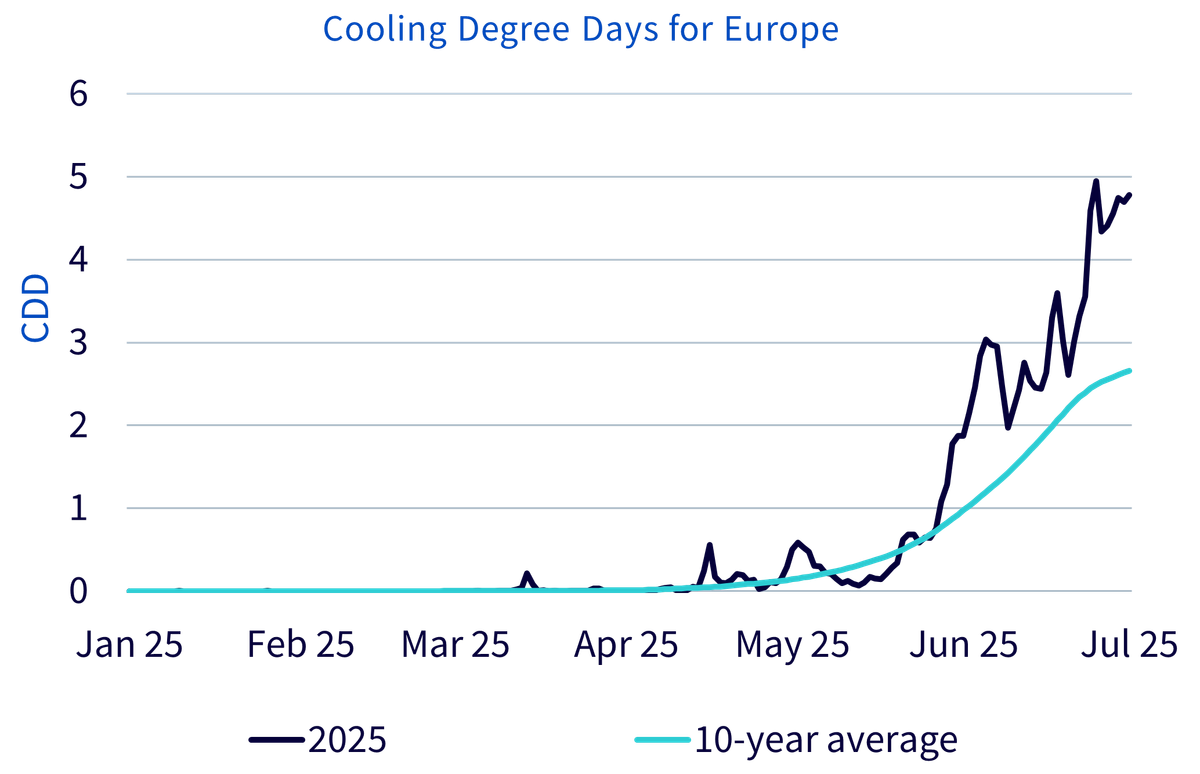
Source: Bloomberg New Energy Finance, European Centre for Medium-Range Weather Forecasts (ECMWF), 3 July 2025. Historical performance is not an indication of future performance and any investments may go down in value.
Looking at temperature anomaly forecasts (i.e. deviations from normal seasonal temperatures), the southern part of the continent is expected to remain hotter than average over the coming week).
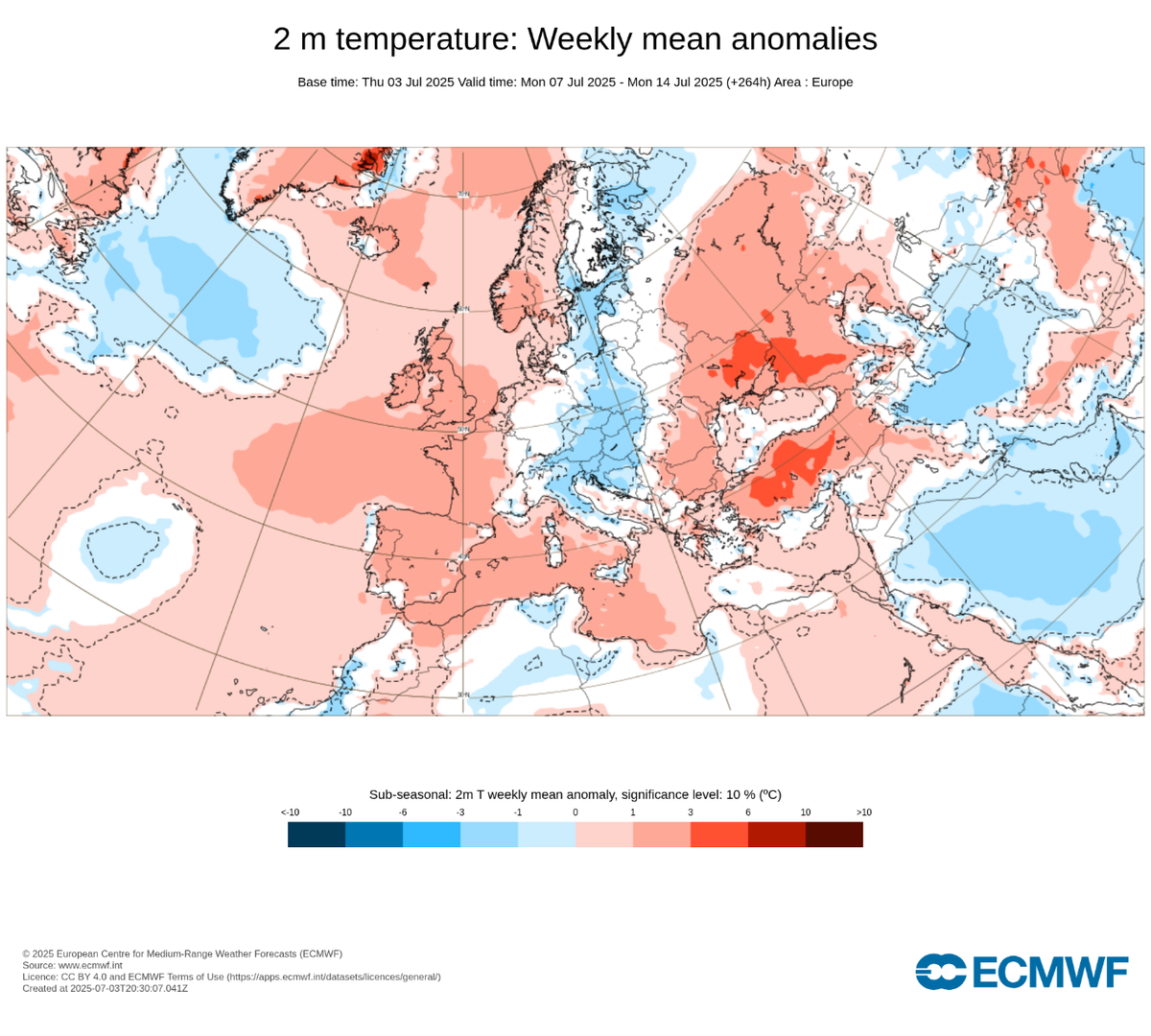
Source: European Centre for Medium-Range Weather Forecasts (ECMWF). Taken on 4 July 2025. Forecast Range 7-14 July 2025. Expected deviation from mean seasonal temperatures based on a 10% significance level. Forecasts are not an indicator of future performance and any investments are subject to risks and uncertainties.
This suggests that elevated power demand may persist in the short term, with several important implications for energy and commodity markets:
Bullish near-term outlook: Rising AC usage boosts gas-fired power generation.
Renewed demand for gas as a flexible backup to intermittent renewables.
Storage of European natural gas is below seasonal average, and more importantly, significantly below the post-2022 era when reliance on storage has increased with the absence of pipeline gas flows from Russia.
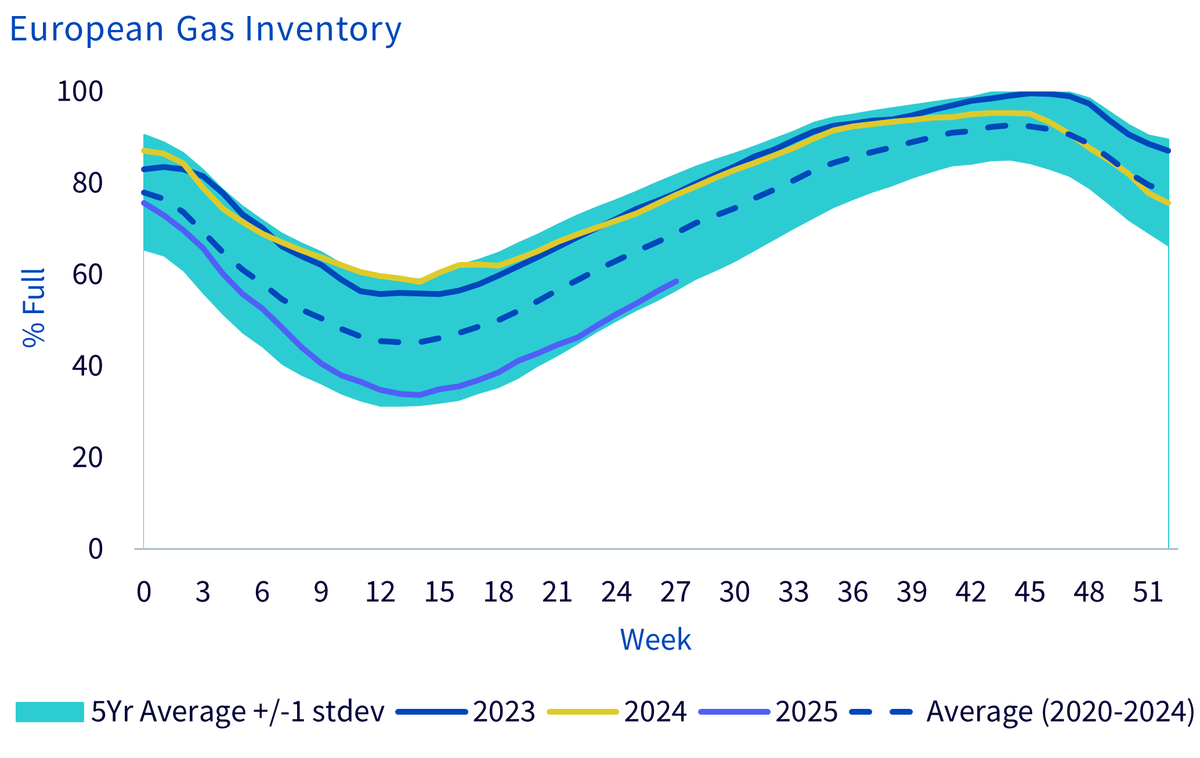
Source: WisdomTree, Bloomberg. January 2019 – June 2025. Historical performance is not an indication of future performance and any investments may go down in value.
The intense sunlight has improved solar power output, helping meet peak cooling loads.
But rising Mediterranean Sea temperatures may enhance storm activity and cloud cover, which could reduce solar generation.
In such scenarios, natural gas and coal may play a larger role.
Any switch to gas raises demand for European Union Allowances (EUAs) due to emissions.
A switch to coal intensifies EUA demand even further, given its higher carbon intensity.
Europe’s recent heatwave offers a vivid preview of how climate volatility, energy consumption, and commodity markets are becoming increasingly intertwined. As temperatures rise, so too does the urgency for both climate adaptation and energy system resilience.
We’ll be watching weather anomalies, power demand data, and carbon pricing closely as these dynamics continue to evolve in the weeks ahead.

Head of Commodities and Macroeconomic Research, WisdomTree Europe
@NiteshShahWTNitesh Shah is a seasoned financial professional with over 24 years of experience in research and investment strategy. As Head of Commodities & Macroeconomic Research at WisdomTree Europe, he leads market analysis and insights across asset classes, with a focus on commodities and exchange-traded products. Previously, he held roles at Moody’s, HSBC Investment Bank, The Pension Protection Fund, and Decision Economics, building expertise in market analysis and strategy. Nitesh earned a master’s degree in International Economics and Finance from Brandeis University and a bachelor's in Economics from the London School of Economics. His insights are frequently featured in financial media, and he is a sought-after speaker at industry events. He also hosts the ‘Commodity Exchange’ podcast, where he discusses trends shaping global markets. Passionate about guiding investors, Nitesh provides actionable insights to help them navigate complex financial landscapes.
